Once upon a time, I tried to cook rice: 22mar2003
I know Katie has memories of me being some kind of romantic guy, but really I'm not. I'm really quite dopey when it comes to impressing the ladies. So when I realized, about halfway through the week, that Valentine's Day was on its way (and it was a one-month anniversary, too), I felt the pressure. I had no idea what to do. When it came down to within twenty-four hours, I planned the only thing I could think of.
I decided to cook her dinner.
Recalling that day, nearly six years ago, I expected it to go wrong all along. Jenny said she'd make something, too, and when she asked what I'd like, I suggested she make whatever she'd like to eat once I failed to make anything edible at all.
I had Mark send me his famous fettuccine Alfredo recipe from J140. He always made it look easy, at least, (and Jenny is a picky eater, but I know she loves fettuccine) so I thought I'd try it.
My car's dead (I suppose I haven't mentioned it, but yeah, the Blue MF is dead), so I'm taking the bus to & from work. If I'd left at 6:30, as scheduled, then I would have gotten back in time to walk to the store, buy the ingredients, and walk home before Jenny got here. Of course, there was some kind of plumbing leak that resulted in water from the Cafe coming into the receiving room, so I didn't leave at 6:30. And if I'd caught the next bus, I'd've gotten home half an hour after Jenny got here. So I waited at work. I'd been wanting to make a CD for her (goodness knows, I can make a mix CD or two, or a thousand), but I've been out of blank CDs. After waiting in the break room for half an hour, I realized there was an Office Depot nearby, so I bought blank CDs and then wandered around the parking lot, talking to Leslie on the phone. It wasn't until t was time for Jenny to leave work did it occur to me that I'd been standing outside a Trader Joe's for half an hour. I could have had the ingredients ready to go.
Ah well.
We left, we went grocery shopping, we came home, and I got to work. And...
It went well.
Considering I didn't know my way around a kitchen, and of course we don't have the pots I required (I'd forgotten this since the last time we tried to make food in Jenn's kitchen, January of last year), it took a while. but it went well. Finally it was as ready as I was going to get it, and I sampled the sauce.
Way salty, way cheesey. Damn and blast! However, once applied to pasta, it was actually pretty damn good.
I don't really have a clever way to wrap up this story. We ate, we watched "The Office" (the first episodes from season 4, when Pam & Jim are dating, so it was all romanticky), and I fell asleep on the couch.
Anyway, I can cook, now.
Sunday, February 15, 2009

Thursday, February 12, 2009
not enough on adventures OR God
I've just spent the past hour giving this blog some attention:
http://thereisabluebird.blogspot.com/
It motivated me to finally set up a new module over there to the right, for the blogs of people I've met who are also looking for something on the road. I hope to expand that into some collaborative project, but I've not yet found the right one...
It also motivated me to finally blog. I've had the internet here for three weeks, and I haven't really done so.
So here we go!
----- ---- --- -- - -- --- ---- -----
(approx 45 minutes in)
"A Biologist Questions Evolution" was the lead-in.
That's news? I like to think that's the job, at least in part, of a biologist.
Anyway, I want to blog about this, but can't get my head into it (probably because I have the interview playing, so I just want to listen to it).
Anyway, she, this biologist, is amazing me by speaking my views and ideas.
One question from the interviewer asks: "Aren't we just quibbling over what you think God is, then?"
Well yes, yes, that is what we are doing within this conversation. Because, in the traditional Evolution vs Creationism debate, isn't science quibbling over what God is not? This biologist, Elisabet Sahtouris, is saying "you've got it all wrong!" Which is exciting, because I think that's the case: Saying 'God does not exist,' is to say 'what I understand God to be does not exist.'
The God I know cannot be denied. But if you think I mean some old beardy man, if you think I mean a sentient being conjured up the world and the stars, if you think I mean Divine Intervention means an invisible hand politely moving something aside like a chess piece, the you're not understanding me.
Elisabet Sahtouris, in this interview, touches on the God I know.
----- ---- --- -- - -- --- ---- -----
Anyway, reading Justine's blog made me want to blog (and blog well) about my adventures, but that will have to wait. Now I'm going to watch last night's lost, and then I've got to catch the bus to work.
http://thereisabluebird.blogspot.com/
It motivated me to finally set up a new module over there to the right, for the blogs of people I've met who are also looking for something on the road. I hope to expand that into some collaborative project, but I've not yet found the right one...
It also motivated me to finally blog. I've had the internet here for three weeks, and I haven't really done so.
So here we go!
----- ---- --- -- - -- --- ---- -----
(approx 45 minutes in)
"A Biologist Questions Evolution" was the lead-in.
That's news? I like to think that's the job, at least in part, of a biologist.
Anyway, I want to blog about this, but can't get my head into it (probably because I have the interview playing, so I just want to listen to it).
Anyway, she, this biologist, is amazing me by speaking my views and ideas.
One question from the interviewer asks: "Aren't we just quibbling over what you think God is, then?"
Well yes, yes, that is what we are doing within this conversation. Because, in the traditional Evolution vs Creationism debate, isn't science quibbling over what God is not? This biologist, Elisabet Sahtouris, is saying "you've got it all wrong!" Which is exciting, because I think that's the case: Saying 'God does not exist,' is to say 'what I understand God to be does not exist.'
The God I know cannot be denied. But if you think I mean some old beardy man, if you think I mean a sentient being conjured up the world and the stars, if you think I mean Divine Intervention means an invisible hand politely moving something aside like a chess piece, the you're not understanding me.
Elisabet Sahtouris, in this interview, touches on the God I know.
----- ---- --- -- - -- --- ---- -----
Anyway, reading Justine's blog made me want to blog (and blog well) about my adventures, but that will have to wait. Now I'm going to watch last night's lost, and then I've got to catch the bus to work.
Thursday, January 22, 2009
"If anything ever goes right, we should worry."
Anybody in or around Seattle who reads this should know: The Center for Wooden Boats hosts free sailing on Lake Union every Sunday, and it's totally worth taking advantage of. Anybody who is not in this area and reads this, and plans to visit here, should try to be here for a Sunday.
Several months ago, Anna and I took advantage, and got to enjoy a trip around the lake on John Wayne's yacht. I went a couple of weeks ago on another yacht, the Discovery, which left the lake and went all the way to the Ballard Locks.
I've been trying to get Jenny to go out there with me for a few weeks, and finally this week she did, and hilarity did ensue.
The last time I went out, I arrived at 11:30 to put myself on the list for the 2:00 sail, and there was room to spare. This week, though, I dragged my feet getting out of bed and we didn't get there until noon. And of course it was a beautiful day--not a cloud in the sky (which would be only the third time I've ever seen such a thing)--and so both lists were full (in the summer they do more than two, but in winter there's less demand). We put our names down for standby for the Discovery, though, and then went to Belltown for breakfast.
The 5-Point is a dive bar near the Seattle Center, which is open 24 hours (I think they are dry from 2:00 to 6:00AM). We got there about halfway through whatever football game was going on (I ceased to care when the Titans lost, yo), and so there were plenty people there, and yes, they were drunk. Our table was by the jukebox, and we enjoyed our breakfast and coffee while a guy danced at the end of our table while telling everybody in the room how great Marvin Gaye was. it was all very loud and dirty and great. That's what breakfast should be. I missed Burning Man.
After breakfast we had some time, so we walked down to the sculpture garden and admired the clear sky from the waterfront. Enjoyed, except for the part where Jenny fell down on a sharp rock, anyway. We walked back to the car.
When we got to CWB, we were lucky enough that three people hadn't shown up, so we made the list. But there were some things I noticed. For one thing, they insisted we wear life jackets. I'd never had to before. And our captain was not Ben, the captain of the Discovery. And then we walked out towards a different pier.
To the longboat Discovery.
Not the yacht Discovery.
The longboat.
Here's the practical difference: on the yacht Discovery, we sailed around Lake Union, getting to see Gasworks Park. The Fremont Bridge was raised for us, and we sailed comfortably under the Ballard Bridge. We got to see Very Pretty Things.
On the longboat Discovery, we got to see our Large Oars, and had to watch those oars constantly, to make sure they were not colliding with everyone else's oar, as we rowed around the lake for an hour. Our captain and his assistant got to see Very Pretty Things--I could tell, because I would hear them say, "Oh, look at that!" and, "What do you think that is?" while we watched our oars.
As we came in, the sun began to set, so we fled to Golden Gardens (i.e., the beach) to admire it. Of course, we were dressed for a brisk-but-sunny day on a yacht, not for the beach. It was beautiful there, but we got very sandy. I was about to throw clothes in the washer when we heard from Jenny's best friend Lisha, and made arrangements to meet her in the U District for supper.
I think that's it for the adventure, except to say that A Pizza Mart in the UD serves really good pizza, and you can get a large plus a pitcher of beer for $13.
But yeah. When I left Hawaii, I consciously chose to follow a Path of Adversity, which has proved true throughout my courtship and pursuit of Jenny. As she said, while we were laughing-to-tears while they loaded us on the longboat, "if anything ever goes right for us, we should worry."
Several months ago, Anna and I took advantage, and got to enjoy a trip around the lake on John Wayne's yacht. I went a couple of weeks ago on another yacht, the Discovery, which left the lake and went all the way to the Ballard Locks.
I've been trying to get Jenny to go out there with me for a few weeks, and finally this week she did, and hilarity did ensue.
The last time I went out, I arrived at 11:30 to put myself on the list for the 2:00 sail, and there was room to spare. This week, though, I dragged my feet getting out of bed and we didn't get there until noon. And of course it was a beautiful day--not a cloud in the sky (which would be only the third time I've ever seen such a thing)--and so both lists were full (in the summer they do more than two, but in winter there's less demand). We put our names down for standby for the Discovery, though, and then went to Belltown for breakfast.
The 5-Point is a dive bar near the Seattle Center, which is open 24 hours (I think they are dry from 2:00 to 6:00AM). We got there about halfway through whatever football game was going on (I ceased to care when the Titans lost, yo), and so there were plenty people there, and yes, they were drunk. Our table was by the jukebox, and we enjoyed our breakfast and coffee while a guy danced at the end of our table while telling everybody in the room how great Marvin Gaye was. it was all very loud and dirty and great. That's what breakfast should be. I missed Burning Man.
After breakfast we had some time, so we walked down to the sculpture garden and admired the clear sky from the waterfront. Enjoyed, except for the part where Jenny fell down on a sharp rock, anyway. We walked back to the car.
When we got to CWB, we were lucky enough that three people hadn't shown up, so we made the list. But there were some things I noticed. For one thing, they insisted we wear life jackets. I'd never had to before. And our captain was not Ben, the captain of the Discovery. And then we walked out towards a different pier.
To the longboat Discovery.
Not the yacht Discovery.
The longboat.
Here's the practical difference: on the yacht Discovery, we sailed around Lake Union, getting to see Gasworks Park. The Fremont Bridge was raised for us, and we sailed comfortably under the Ballard Bridge. We got to see Very Pretty Things.
On the longboat Discovery, we got to see our Large Oars, and had to watch those oars constantly, to make sure they were not colliding with everyone else's oar, as we rowed around the lake for an hour. Our captain and his assistant got to see Very Pretty Things--I could tell, because I would hear them say, "Oh, look at that!" and, "What do you think that is?" while we watched our oars.
As we came in, the sun began to set, so we fled to Golden Gardens (i.e., the beach) to admire it. Of course, we were dressed for a brisk-but-sunny day on a yacht, not for the beach. It was beautiful there, but we got very sandy. I was about to throw clothes in the washer when we heard from Jenny's best friend Lisha, and made arrangements to meet her in the U District for supper.
I think that's it for the adventure, except to say that A Pizza Mart in the UD serves really good pizza, and you can get a large plus a pitcher of beer for $13.
But yeah. When I left Hawaii, I consciously chose to follow a Path of Adversity, which has proved true throughout my courtship and pursuit of Jenny. As she said, while we were laughing-to-tears while they loaded us on the longboat, "if anything ever goes right for us, we should worry."
Monday, December 8, 2008
life life life, la la la
When I used to sit around in Tennessee, I kept thinking "I should be doing something else." I hated that feeling, and I associated it with sitting around doing nothing (i.e., watching TV, or surfing the internet). While I was in Tucson I tried to get out a lot, but eventually got lazy again, and so when I moved to Seattle, I hit the ground running (nevermind my first two weeks, when I just sat around depressed). Hiking/camping in the rain forest! Walking, constantly! Always downtown, doing something, or at home reading or talking with Jenn or on the phone.
Since I came back from Tennessee, I've been more on the lazy side: spending my days off in the living room; hardly ever making it downtown; not looking for adventures to have.
And yet I haven't felt bad about it. I do, when I think about it, but when I think of how I've been using my time, I don't feel bad. I do watch TV, especially when Josh is home, since it's usually on. But a decent percentage of time, I've been reading or meditating, and the results have been crazy. I feel I'm more myself than usual. I feel more connected with others (this, especially, is a result of some of the reading I've done).
Last night, though, I was really worked up. I don't know what it was about yesterday, but I had a ton of energy while I was at work, and once I got home, it turned into racing thoughts. Josh and I watched Bigger Stronger Faster, a documentary about steroids, and I was thinking in so many tangents to the subjects tackled that the movie seemed to be five hours long (it's actually 1h40m), and I even had to step out on the balcony to clear my head for a moment.
I've often thought about needing a break, but even when I have I thought it was a cop-out, just an excuse for me to be lazy for a bit. But I wonder if I don't just sometime need one. I think if last night had gone on like that much longer, I would have been physically sick; I eventually went to the store and bought beer to "put out the fire," so to speak.
But generally, things are really good. A few of the books I've read recently (Wild At Heart, Leadership and Self-Deception, and Captivating) have had profound and life-altering impacts on me. I would be grateful for the time to do some serious writing, except that, with the overwhelming speed of my thoughts, I don't know if I possibly could. I would be especially glad for the chance to just talk everything in my head out.
For now, though, I think I'm going to go be grateful for some Taco Bell. Mmmm.
Since I came back from Tennessee, I've been more on the lazy side: spending my days off in the living room; hardly ever making it downtown; not looking for adventures to have.
And yet I haven't felt bad about it. I do, when I think about it, but when I think of how I've been using my time, I don't feel bad. I do watch TV, especially when Josh is home, since it's usually on. But a decent percentage of time, I've been reading or meditating, and the results have been crazy. I feel I'm more myself than usual. I feel more connected with others (this, especially, is a result of some of the reading I've done).
Last night, though, I was really worked up. I don't know what it was about yesterday, but I had a ton of energy while I was at work, and once I got home, it turned into racing thoughts. Josh and I watched Bigger Stronger Faster, a documentary about steroids, and I was thinking in so many tangents to the subjects tackled that the movie seemed to be five hours long (it's actually 1h40m), and I even had to step out on the balcony to clear my head for a moment.
I've often thought about needing a break, but even when I have I thought it was a cop-out, just an excuse for me to be lazy for a bit. But I wonder if I don't just sometime need one. I think if last night had gone on like that much longer, I would have been physically sick; I eventually went to the store and bought beer to "put out the fire," so to speak.
But generally, things are really good. A few of the books I've read recently (Wild At Heart, Leadership and Self-Deception, and Captivating) have had profound and life-altering impacts on me. I would be grateful for the time to do some serious writing, except that, with the overwhelming speed of my thoughts, I don't know if I possibly could. I would be especially glad for the chance to just talk everything in my head out.
For now, though, I think I'm going to go be grateful for some Taco Bell. Mmmm.
Saturday, November 29, 2008
recently
Three weird dreams last night: one was set at work, another at a park, and the other in an old resedential area of some small town. The weird thing about the dreams is that all three ended with Dick (an older co-worker of mine) crawling into some body of water (a pond, an ocean, a river) chanting, "Change, change, change..."
Anyway, the past two weeks have been really interesting. Chris came to visit, and we did a pretty good job of exploring. The night he came in, we went out for Mexican, and then visited a couple of bars (I'm not much on drinking these days, but a visiting friend was something to celebrate). I expected to spen most of the next day at the Market, but it was practically abandoned and therefore took only half an hour. So we saw the waterfront, and the library, and the Seattle Center (including the Space Needle).

Day two was a lazy day; we didn't head into town until afternoon, and then we took the Underground Tour and visited Elliott Bay Book Company, and then we met up with Jenny & Elijah for a fire on the beach (it's still not very rainy here, so may as well take advantage...). As usual, we were kicked off the beach around 2, but by then we were out of wood & beer. I worked Friday, and we wound up watching Tropic Thunder with Josh, Jenn and Dustin afterwards.
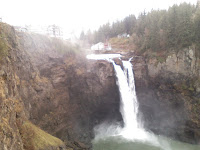
Saturday was the most fun, I think. We spent that day driving around Snoqualmie, Fall City and a little bit of North Bend looking for locations from "Twin Peaks." Snoqualmie Falls (where they shot the externals for The Great Northern) was gorgeous:
We also found The Roadhouse (which is now a restaurant called The Roadhouse):

I totally failed to take pictures of the train in which Laura Palmer was killed, nor of the great big log. But I did get a picture of the sheriff's station, which was probably the trickiest and most exciting find (unfortunately, the sun was long set once we'd found it)... I'll have to go back in the light sometime to get better pictures, as you can see the whole lobby area, as well as the wood-paneled conference room. But you can at least see the lobby and the sillouhette of the sundial in this picture:

After all that fun, we headed back to Seattle, where Jenny met us with free tickets to the Thunderbirds game. I don't know a whole lot about hockey, but I do know a good fight when I see one:
Also, a bunch of kids:

I could go on about the past week (it's amazing to think that it's been a week since all that Twin Peaks business), however Jenn's laptop died so I'm back to library computers, and I've got thirteen minutes left to go. I'm going to write more, though... lots to say, actually. Nobody's commented directly to my last post, but I got lots of comments on the facebook note that directs TO the blog, so if you're friendly with me on facebook, feel free to join the discussions. And maybe next time I get online I'll be able to join as well...
Anyway, the past two weeks have been really interesting. Chris came to visit, and we did a pretty good job of exploring. The night he came in, we went out for Mexican, and then visited a couple of bars (I'm not much on drinking these days, but a visiting friend was something to celebrate). I expected to spen most of the next day at the Market, but it was practically abandoned and therefore took only half an hour. So we saw the waterfront, and the library, and the Seattle Center (including the Space Needle).

Day two was a lazy day; we didn't head into town until afternoon, and then we took the Underground Tour and visited Elliott Bay Book Company, and then we met up with Jenny & Elijah for a fire on the beach (it's still not very rainy here, so may as well take advantage...). As usual, we were kicked off the beach around 2, but by then we were out of wood & beer. I worked Friday, and we wound up watching Tropic Thunder with Josh, Jenn and Dustin afterwards.
Saturday was the most fun, I think. We spent that day driving around Snoqualmie, Fall City and a little bit of North Bend looking for locations from "Twin Peaks." Snoqualmie Falls (where they shot the externals for The Great Northern) was gorgeous:

We also found The Roadhouse (which is now a restaurant called The Roadhouse):

I totally failed to take pictures of the train in which Laura Palmer was killed, nor of the great big log. But I did get a picture of the sheriff's station, which was probably the trickiest and most exciting find (unfortunately, the sun was long set once we'd found it)... I'll have to go back in the light sometime to get better pictures, as you can see the whole lobby area, as well as the wood-paneled conference room. But you can at least see the lobby and the sillouhette of the sundial in this picture:

After all that fun, we headed back to Seattle, where Jenny met us with free tickets to the Thunderbirds game. I don't know a whole lot about hockey, but I do know a good fight when I see one:

Also, a bunch of kids:

I could go on about the past week (it's amazing to think that it's been a week since all that Twin Peaks business), however Jenn's laptop died so I'm back to library computers, and I've got thirteen minutes left to go. I'm going to write more, though... lots to say, actually. Nobody's commented directly to my last post, but I got lots of comments on the facebook note that directs TO the blog, so if you're friendly with me on facebook, feel free to join the discussions. And maybe next time I get online I'll be able to join as well...
Monday, November 17, 2008
Wednesday, November 12, 2008
Daniel Quinn on schooling
from Providence: The Story of a Fifty-Year Vision Quest, by Daniel Quinn
pp. 118 - 125
One of the great, persistent myths of education in our culture is that children become reluctant learners as they grow older. In fact, what they become reluctant about is going to school, where they're bullied, regimented, bored silly, and very effectively prevented from learning. The learning curve of small children is simply phenomenal during the first five years of their life. They learn the language of their parents--several languages, if several are spoken. They learn four fifths of the vocabulary they'll use in their everyday activities for the rest of their lives. They easily learn to walk, run, skip, swim, ride a bicycle, draw, print, count, and hundreds of other things they'll do for the rest of their lives (including reading, if parents will give them a little help). But as soon as they enter school, this learning curve begins to level off, and within a few years it's practically flat. And the children are blamed for this. In effect, the educators say, "See? If it weren't for the hard work we do, these kids wouldn't be learning ANYTHING!"
One of the absolute principles of education that every teacher learns is that children learn something very easily when they're ready to learn it, which is to say, when they want to learn it. The classic example is batting averages. Kids who become interested in baseball learn to figure batting averages without the slightest effort--without being "taught" at all. It's as though they take it in through their pores. Children find this operation extremely difficult to learn when it's taught as a subject in class, but if they have a reason to learn it--their own reason--they learn it in no time.
As I say, everyone in education knows this--but they would never dream of allowing children to learn this way as a general rule. That wouldn't do at all, because of course how would you organize such a thing? How can you possibly know when a given child will develop a reason to learn how to read a map? And what would you do when you found out? No, the only way to organize learning is to give children a reason to learn all at the same time. This is called motivating them. You have thirty children in your class and the curriculum says it's time to teach them some map-reading skills, so now you motivate them to learn about maps. You try to manufacture something that approximates the interest kids have when they learn to figure batting averages.
Of course it doesn't work, that goes without saying. No one expects it to work. When kids learn to figure batting averages, they're responding to a motivation that arises within them. This is something they want to do. No matter. Your task is to "motivate," so you "motivate"--the more the better.
----- ---- --- -- - -- --- ---- -----
Our entire program is based on this argument: "We know kids learn effortlessly if they have their own reasons for learning, but we can't wait for them to find their own reasons. We have to provide them with reasons that are not their own. This doesn't work and we know it doesn't work, but it's the only practical way to organize our schools."
What? How would I organize the schools? To ask this question presupposes that we must have schools, doesn't it? I prefer to think about problems the way engineers do. If a valve doesn't work, they don't say, "Well, we must have valves, so lets try two valves." If a valve doesn't work, they say, "Well, what would work?" Their rule is, if it doesn't work, don't do it more, do something else.
We know what works for children up to the age where we ship them off to school: Let them be around you, pay attention to them, talk to them, give them access to as much as you can, let them try things, and that's it. They'll take care of the rest. you don't have to strap small children down and teach them to speak, all you have to do is talk to them. You don't have to give them crawling lessons or walking lessons or running lessons. you don't have to spend an hour a day showing them how to bang two pots together; they'll figure that out all by themselves--if you give them access to the pots.
Nothing magical happens at the age of five to render this process obsolete or invalid. you would know this if you observed what happens in cultures that we in our arrogant stupidity call primitive. in primitive cultures, parents simply go on keeping the children around, paying attention to them, talking to them, giving them access to everything, letting them try out things for themselves, and that's it. They don't herd them together for courses in tracking, pottery making, plant cultivating, hunting and so on. That's totally unnecessary. They don't give them history lessons or craft lessons or art lessons or music lessons, but--magically--all the kids grow up knowing their history, knowing their crafts, knowing their arts, knowing their music. Every kid grows up knowing everything--without a single minute spent in anything remotely like a school. No tests, no grades, no report cards. Every kid learns everything there is to learn in that culture because sooner or later every kid feels within himself or herself the need to learn it--just the way some kids in our culture get to the point where they feel the need to learn how to compute batting averages...
Yes, I understand--believe me, I do. What you're saying is exactly what our educators would say: "That system might work in primitive cultures, but it won't work in ours, because we just have too much to learn." This is just ethnocentric balderdash; you might not like to hear this, but any anthropologist will confirm it: What children learn in other cultures isn't less, it's different. And in fact nothing is too much to learn if kids want to learn it. Take the case of teenage computer hackers. These kids, because they want to, manage--unaided!--to achieve a degree of computer sophistication that matches or surpasses that of whole teams of people with advanced degrees and decades of experience. Give kids access and they'll learn. Restrict their access to learning, and they won't--and this is function of our schools, to restrict kids' access to learning, to give them what educators think they should know, when they think they should know it, one drop at a time.
Are you able to remember yourself at age five, seven, nine, ten? Do you recall yearning to be allowed to sit in a classroom for six hours a day? No, neither do I. Do you remember where you wanted to be? Or can you imagine where you might have wanted to be? Well, yes, certainly our-of-doors, not in a school, but...
Here, let me imagine a place for you. it's a sort of circus, a collection of acrobats, jugglers, animal trainers, high-wire artists, clowns, dancers--the whole thing, every kind of performer you'd expect to find in a circus. And this place is parked nearby and it's open round the clock and the idea is anyone can walk in and say to any of these performers, "Hey, I'd like to learn how to do that!" and they say, "Well, of course! That's what we're here for!"
Of course there'd be room here for a lot more. Maybe a small zoo where you could learn to take care of the animals yourself. Maybe somebody would have a pretty good telescope and could show you what's what in the nighttime sky and lend you some books if you're interested. And maybe there'd be a photographer with a bunch of cameras and a darkroom, and somebody with a printing press and a bindery. And while we're at it, why not a weaver and a potter and a sculptor and a painter and a pianist and a violinist, and maybe even someone who knows how to build a piano and how to make a violin? And indeed there would always be building projects under way, so you could learn how to use all the tools and read the blueprints and all that. And someone who was always prepared to take bunch of kids out into the wilderness to learn whatever there is to learn out there. And maybe an archaeologist who could take some kids off to a dig someplace. And you could even have a writer on hand in case someone was crazy enough to want to find out what that's all about. And a roomful of computers, with someone who knew how to use them. And somewhere in there someone who could teach you any math you wanted to learn, and someone else who could teach you any electronics or physics you wanted to learn, and so on. And gee, everybody has books they can lend you. For your young entrepreneurs, you could even have people around you who could help them make and market their products.
Are you getting the idea here? I could go on for hours this way.
Anyway, the rule is, you can come and go as you please, do anything you please, study with anyone you please for as long as you please. How does this sound as someplace you might rather have been than in a classroom? ...
Exactly, exactly. It's be a never-ending feast of learning, and if you wanted to keep kids out, you'd have to put up a razor-wire fence....
Oh, well, of course educators would hate it. Educators would be superfluous in such a setup" functionless. They'd say, "Sure everyone's having a wonderful time, but how do you know they're getting a rounded education?" My answer to that is, "Rounded according to whom?" and "Rounded as of when?" Who says education has to end at eighteen? Or at age twenty-two? If there were a place like that in my neighborhood, I'd be ensconced there right now, teaching writing, teaching editing, teaching publishing, teaching word processing, teaching everything I have to teach--and learning, getting that "rounded education" I certainly didn't get in sixteen years of schooling....
No, don't call this a school. Didn't you hear what I just said? it isn't a school, it's a city. It's a place where people who are willing to let their children have access to them. People who are willing to let the children of the community hang around, willing to pay attention to them, willing to talk to them, willing to show them how things work, willing to show them how to do things, willing to let them try out things for themselves. Nothing difficult, nothing very demanding, just the ordinary things people did on this planet for the first three million years of human life.
People in this city wouldn't get as much "done" as people in New York City, wouldn't have as sharp a competitive edge, but they'd have a hell of a lot more fun and they'd find out what it's like to live as human beings instead of workers--and they wouldn't pay a nickel in school taxes. It would be costly in terms of time, of course, but how many hours does the average worker spend right now paying for a system that doesn't work?
pp. 118 - 125
One of the great, persistent myths of education in our culture is that children become reluctant learners as they grow older. In fact, what they become reluctant about is going to school, where they're bullied, regimented, bored silly, and very effectively prevented from learning. The learning curve of small children is simply phenomenal during the first five years of their life. They learn the language of their parents--several languages, if several are spoken. They learn four fifths of the vocabulary they'll use in their everyday activities for the rest of their lives. They easily learn to walk, run, skip, swim, ride a bicycle, draw, print, count, and hundreds of other things they'll do for the rest of their lives (including reading, if parents will give them a little help). But as soon as they enter school, this learning curve begins to level off, and within a few years it's practically flat. And the children are blamed for this. In effect, the educators say, "See? If it weren't for the hard work we do, these kids wouldn't be learning ANYTHING!"
One of the absolute principles of education that every teacher learns is that children learn something very easily when they're ready to learn it, which is to say, when they want to learn it. The classic example is batting averages. Kids who become interested in baseball learn to figure batting averages without the slightest effort--without being "taught" at all. It's as though they take it in through their pores. Children find this operation extremely difficult to learn when it's taught as a subject in class, but if they have a reason to learn it--their own reason--they learn it in no time.
As I say, everyone in education knows this--but they would never dream of allowing children to learn this way as a general rule. That wouldn't do at all, because of course how would you organize such a thing? How can you possibly know when a given child will develop a reason to learn how to read a map? And what would you do when you found out? No, the only way to organize learning is to give children a reason to learn all at the same time. This is called motivating them. You have thirty children in your class and the curriculum says it's time to teach them some map-reading skills, so now you motivate them to learn about maps. You try to manufacture something that approximates the interest kids have when they learn to figure batting averages.
Of course it doesn't work, that goes without saying. No one expects it to work. When kids learn to figure batting averages, they're responding to a motivation that arises within them. This is something they want to do. No matter. Your task is to "motivate," so you "motivate"--the more the better.
----- ---- --- -- - -- --- ---- -----
Our entire program is based on this argument: "We know kids learn effortlessly if they have their own reasons for learning, but we can't wait for them to find their own reasons. We have to provide them with reasons that are not their own. This doesn't work and we know it doesn't work, but it's the only practical way to organize our schools."
What? How would I organize the schools? To ask this question presupposes that we must have schools, doesn't it? I prefer to think about problems the way engineers do. If a valve doesn't work, they don't say, "Well, we must have valves, so lets try two valves." If a valve doesn't work, they say, "Well, what would work?" Their rule is, if it doesn't work, don't do it more, do something else.
We know what works for children up to the age where we ship them off to school: Let them be around you, pay attention to them, talk to them, give them access to as much as you can, let them try things, and that's it. They'll take care of the rest. you don't have to strap small children down and teach them to speak, all you have to do is talk to them. You don't have to give them crawling lessons or walking lessons or running lessons. you don't have to spend an hour a day showing them how to bang two pots together; they'll figure that out all by themselves--if you give them access to the pots.
Nothing magical happens at the age of five to render this process obsolete or invalid. you would know this if you observed what happens in cultures that we in our arrogant stupidity call primitive. in primitive cultures, parents simply go on keeping the children around, paying attention to them, talking to them, giving them access to everything, letting them try out things for themselves, and that's it. They don't herd them together for courses in tracking, pottery making, plant cultivating, hunting and so on. That's totally unnecessary. They don't give them history lessons or craft lessons or art lessons or music lessons, but--magically--all the kids grow up knowing their history, knowing their crafts, knowing their arts, knowing their music. Every kid grows up knowing everything--without a single minute spent in anything remotely like a school. No tests, no grades, no report cards. Every kid learns everything there is to learn in that culture because sooner or later every kid feels within himself or herself the need to learn it--just the way some kids in our culture get to the point where they feel the need to learn how to compute batting averages...
Yes, I understand--believe me, I do. What you're saying is exactly what our educators would say: "That system might work in primitive cultures, but it won't work in ours, because we just have too much to learn." This is just ethnocentric balderdash; you might not like to hear this, but any anthropologist will confirm it: What children learn in other cultures isn't less, it's different. And in fact nothing is too much to learn if kids want to learn it. Take the case of teenage computer hackers. These kids, because they want to, manage--unaided!--to achieve a degree of computer sophistication that matches or surpasses that of whole teams of people with advanced degrees and decades of experience. Give kids access and they'll learn. Restrict their access to learning, and they won't--and this is function of our schools, to restrict kids' access to learning, to give them what educators think they should know, when they think they should know it, one drop at a time.
Are you able to remember yourself at age five, seven, nine, ten? Do you recall yearning to be allowed to sit in a classroom for six hours a day? No, neither do I. Do you remember where you wanted to be? Or can you imagine where you might have wanted to be? Well, yes, certainly our-of-doors, not in a school, but...
Here, let me imagine a place for you. it's a sort of circus, a collection of acrobats, jugglers, animal trainers, high-wire artists, clowns, dancers--the whole thing, every kind of performer you'd expect to find in a circus. And this place is parked nearby and it's open round the clock and the idea is anyone can walk in and say to any of these performers, "Hey, I'd like to learn how to do that!" and they say, "Well, of course! That's what we're here for!"
Of course there'd be room here for a lot more. Maybe a small zoo where you could learn to take care of the animals yourself. Maybe somebody would have a pretty good telescope and could show you what's what in the nighttime sky and lend you some books if you're interested. And maybe there'd be a photographer with a bunch of cameras and a darkroom, and somebody with a printing press and a bindery. And while we're at it, why not a weaver and a potter and a sculptor and a painter and a pianist and a violinist, and maybe even someone who knows how to build a piano and how to make a violin? And indeed there would always be building projects under way, so you could learn how to use all the tools and read the blueprints and all that. And someone who was always prepared to take bunch of kids out into the wilderness to learn whatever there is to learn out there. And maybe an archaeologist who could take some kids off to a dig someplace. And you could even have a writer on hand in case someone was crazy enough to want to find out what that's all about. And a roomful of computers, with someone who knew how to use them. And somewhere in there someone who could teach you any math you wanted to learn, and someone else who could teach you any electronics or physics you wanted to learn, and so on. And gee, everybody has books they can lend you. For your young entrepreneurs, you could even have people around you who could help them make and market their products.
Are you getting the idea here? I could go on for hours this way.
Anyway, the rule is, you can come and go as you please, do anything you please, study with anyone you please for as long as you please. How does this sound as someplace you might rather have been than in a classroom? ...
Exactly, exactly. It's be a never-ending feast of learning, and if you wanted to keep kids out, you'd have to put up a razor-wire fence....
Oh, well, of course educators would hate it. Educators would be superfluous in such a setup" functionless. They'd say, "Sure everyone's having a wonderful time, but how do you know they're getting a rounded education?" My answer to that is, "Rounded according to whom?" and "Rounded as of when?" Who says education has to end at eighteen? Or at age twenty-two? If there were a place like that in my neighborhood, I'd be ensconced there right now, teaching writing, teaching editing, teaching publishing, teaching word processing, teaching everything I have to teach--and learning, getting that "rounded education" I certainly didn't get in sixteen years of schooling....
No, don't call this a school. Didn't you hear what I just said? it isn't a school, it's a city. It's a place where people who are willing to let their children have access to them. People who are willing to let the children of the community hang around, willing to pay attention to them, willing to talk to them, willing to show them how things work, willing to show them how to do things, willing to let them try out things for themselves. Nothing difficult, nothing very demanding, just the ordinary things people did on this planet for the first three million years of human life.
People in this city wouldn't get as much "done" as people in New York City, wouldn't have as sharp a competitive edge, but they'd have a hell of a lot more fun and they'd find out what it's like to live as human beings instead of workers--and they wouldn't pay a nickel in school taxes. It would be costly in terms of time, of course, but how many hours does the average worker spend right now paying for a system that doesn't work?
Subscribe to:
Posts (Atom)